BACK TO BITS AND PIECES
JACK CRAWFORD 1775-1831
Sunderland’s Famous Hero

Jack Crawford was born on the 22nd of March 1775 at Pottery Bank, which was then called Thornhill’s Bank, in the East End of Sunderland, situated at the bottom of High Street East.

In the late 1700’s Sunderland was a busy industrial port some of the manufacturing businesses at the time-included glass , timber yards, boat builders,

Jack's birthplace

POTTERY BANK 1880’S

sail and rope makers and many more. As the population began to grow due to the bigger demand for coal and lime Sunderland provided a perfect hunting ground for the highly feared press-gangs.

Many wars were going on in the late 1700’s and early 1800’s. All kinds of people from young boys to old men were forced or “pressed” into the Navy. Gangs of men were employed to ensure that there were enough sailors to man British war ships. Men did not want to join the navy due to having to be at sea for months or even years on end. Living in cramped conditions where disease was common, and fresh food was very rare and many men being killed or injured in the sea battles.

Jacks father was a keel man who owned one of the seven hundred and fifty keelboats, which operated on the river Wear. These keelboats ferried coal from the staiths as far up-river as Finchale Abbey, to one of the many coal ship lying in the river and off shore. A long tradition for over two hundred years amongst keel men was to train their sons to follow in this family tradition, so it was that Jack at a very young age became a keel man alongside his father. This job was so important, that press-gangs were only allowed to press keel men for the Royal Navy, if they looked like they were going to go on strike. The Navy could also use them as a reserve force, but only in times of emergency. Keelboats were small boats that could be sailed or punted on the river. The uniform they all wore was a short blue jacket, grey trousers, yellow waistcoat, white shirt and blue cap. Their job was very hard work and poorly paid, it also placed them at the bottom of the social ladder.

Around the age of eleven Jack joined the crew of the “Peggy” at South Shields as an apprentice. In 1796 he was press-ganged into the Royal Navy and served on “H.M.S. Venerable” under Admiral Duncan, who was Commander-in-Chief of the North Seas.
Venerable at Campertown

H.M.S. VENERABLE

In 1797, Britain was at war with France, Holland and Spain. On the 11th October the British and Dutch navies met in battle off the coast of Holland, near to Camperdown. The Dutch fleet had planned to join up with French fleet to invade Ireland and then proceed to attack Britain. So when the British engaged them off Camperdown, instead of forming a line of ships to go down one side of the Dutch, Admiral Duncan split the fleet into two lines so they could go down both sides. The Dutch had not anticipated of this, which resulted in them losing the battle. During the fierce fighting the main mast of H.M.S. Venerable was hit
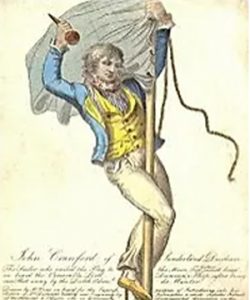
three times, which resulted in the Admiral’s flag crashing to the deck. The Venerable being the command ship and if the Admiral’s flag was not flying could mean the battle had been lost. Jack seeing what had happened picked up the flag and under heavy fire climbed the broken mast to nail it back

Nailing the Colours

in place with a marlinspike to show the battle was not lost. While doing this brave action Jack sustained a bullet through the cheek, which was to trouble him for the rest of his life. From this daring deed came the saying, show your true colours and nail them to the mast.

When news of this great victory reached England there were great celebrations no more so than in Sunderland, the people at the time being unaware of Jacks great bravery. When they eventually heard they presented Jack with a silver medal in 1798.

He received many other honours, but no more than to wear his medal and walk behind Nelson’s coffin at his state funeral in 1806. After the funeral he was presented to King George III and granted a pension of £30 a year.

He married a Sunderland shipbuilder’s daughter in St. Paul’s Church London in 1808, before returning to Sunderland to work back on the keelboats. He found himself to be very popular with people in the pubs who would buy him drinks. But having three sons and one daughter to support, he soon found that his pension and wage did not stretch far enough.

Jack's medal

Jack's silver medal

Thus he became an alcoholic, but he never boasted of his heroic deed. One famous story told in the east end pubs, was of him riding on the back of a large pig down High Street East. So it was that his medal ended up in the pawnshop where it remained for many years eventually being obtained by Sunderland museum where it is still on display.
In 1831 he was the second person to contact cholera in Sunderland and died on the 10th November. He was buried in an unmarked grave in the Holy Trinity Church yard in the East End of Sunderland. It was not until 1888 that a
headstone was erected, which still stands today. Two years later, in 1890 the grandson of Admiral Duncan unveiled a bronze statue in Mowbrey Park to commemorate Jack’s great deed.
Jack's Statue
CLICK TO RETURN TO THE TOP