Jane's Journal
|
Sunderland, My Native Town My earliest recollections at Wearmouth where I was born in 1827 at the west end of Sunderland is that it was a much smaller town than now. It was surrounded by fields and market gardens on the North, South and West end, when children, we used to be very pleased to go to the gardens and see the vegetables and fruit gathered fresh from the gardens and trees. On Saturdays it was a special pleasure to journey along Ryhope or Turnstall lanes to the famous farms, sometimes having tea and strawberries and cream. And then "Boydon Hill" was another great attraction, where at Easter tide, more especially children of all ages would gather to bowl their oranges and coloured eggs down the grassy slopes. Although I cannot remember the house where I was born, I can remember the yard in its rear where there stood a large stack of hay and underneath, being raised a little from the ground, the fowls could get and make nests. One day, being then only three years old, I ran in to tell Mamma in high glee that I could see a lot of beautiful eggs under the hay. The effort of getting them into my basket and dear Mamma helping me to convey them, is I think the only vivid recollection of the home where I was born. We soon removed to Northumberland Street, a house with plenty of stabling and yard adjoining. I can remember my Father often talking here about his beautiful horses that were the "Pride of Sunderland", and when at home he would always see that they were fed and attended to before he took his own meals. I can well remember the earliest influences for good. On Sunday morning I used to go with my father to Primitive Methodist Chapel, a long walk down the High Street, Mother remaining at home with John, Martin and babies Anne, Emma and Louisa. In the afternoon my father used to have us around the table where the large family bible was placed, and he would read portions to us and explain the meaning as well as the pictures. We also had to learn a hymn, or part of one as soon as we were able. I think about this time, my dear parents became Wesleyans, for they worshipped at good old Sans Street Chapel. And about this time 1832, the Asiatic cholera had the first outbreak in England, and when in London alone, 5,275 persons died. In the years 1848-49 the number was 14,137 persons dead. In the year 1854 the number was 10,738 persons dead. In the year 1866 the number was 5,596 persons dead. There were many horror stricken people who fell ill and died in such a short space of time, especially in the first outbreak, that if Sunderland was anything like London, it was indeed a picture of gloom and distress, reminding one of the Plague in 1666. I remember one sight that deeply touched my dear mother’s sympathetic heart and my little one. It was the funeral procession of Mr and Mrs Collins who died within a very short space of each other leaving 11 children to mourn their loss. I don’t remember much more, being only 5 years old, about the terrible scourge but I think it lasted many months. During the seven years we lived in this house in Northumberland Street, I can remember the many happy times we had as children with other companions, often visiting my Father’s family at Pallion, and how we used to enjoy those walks along the lanes, gathering wild flowers and talking over our girlish pleasures of the hay fields and other innocent diversions. I well recollect Sarah Jobbling, Eleanor Oats and Hannah Briggs, the father of whom I was grieved to hear died about two years after I was married. In the home I was taught to be orderly and neat in my habits. My dear Mother was rather delicate, having a constitutional cough since early life, which was the cause of my father about this time laying aside his pipes and saying he would never smoke again, which resolution he kept to the end. I have a vivid recollection of my dear parent’s methodical and industrious habits, my Father in all his vast business concerns and my Mother in her home neatness, punctuality and order. Summer holidays were not thought so necessary as in the present age of hustle and bustle, but on one or two occasions in these early years of my girlhood I can remember very pleasant times at the old fashioned City of Durham, with its noble cathedral, its jail, and its many lovely woods and dales. Durham, then so picturesque was famous for wood and water. In these days stage coaches used to run once or twice a week from Sunderland to these adjacent places, as no railways were yet made, travelling was by no means so easy then as now. I went to a day school kept by Miss Peacock. I remember her face quite well; the school was very select, and only a limited number of girls taken. I distinctly remember also Mr Campbell, a Scotch gentleman, who used to visit the school three times a week to teach for one hour, arithmetic and writing on Mondays, Wednesdays and Fridays. This school life I much enjoyed. It was a pleasant change for me after being so used to nursing and playing with the little ones. During the year 1839, a new house was built for our occupation, my Father superintending this as others, always giving his mind to the enterprise of various kinds in his usual energetic style. After the death of my dear sister, we were thankful when the new house was ready, so that dear mother got a change of scenes, and be enabled to leave sad memories behind. This double fronted house was called Sunderland Villa, and was situated at the corner of John Street and joining the park in front in the Borough Road. The new chapel in Fawcett Street being nearer, we took sittings there, where we worshipped as long as we lived in Sunderland, but nothing could erase from my memory former happy times listening to many of the sainted worthies who occupied the pulpit of dear old Sans Street. Amongst others were the Rev Robert Newton, Samuel and Thomas Jackson, William Dawson, better known as "Billy" Dawson, Squire Brooks and his coachman (Praying Johnny). About this time it was my privilege to hear the Rev Doctor Dixon, Rev Robert Newton and the wonderful "Billy" Davidson, who I can remember on one occasion preaching a most powerful sermon from the parable of "The Prodigal Son". At this time we had as resident ministers: the Rev Isaac Keeling, Rev William Allen and Rev Thomas Capp. The circuit chapels were Burleigh Street, and good old Sans Street, and Fawcett lately built. After a short period in London I was back in Sunderland in the year 1846-47 where my father was connected with the Sacristan colliery, where his brother George was manager. Mr T Fletcher was in charge of the coal office in Borough Road Sunderland. In connection with the colliery, the name of Mr W B Earl of Durham, a timber merchant should be mentioned as the owner of 1/3 and also that of John Thwaites of Waterloo Hotel, Durham, as the owner of another 1/3 of the same property. |
|
My Father’s People My father, John Ray, was born in humble circumstances in the parish of St Giles-in-the-Fields, London in the year 1803. He removed to Gateshead about the year of 1807 and soon afterwards again removed to Sunderland. His father was by trade a dyer. His mother’s maiden name was Sophia Burling, and when about 17 years old, my father’s first great sorrow was the death of his dear mother, after a very painful illness, borne with Christian patience and fortitude. He had three brothers: Martin, William and George, also three sisters: Sophia, Charlotte and Eleanor. My father continued two years in the dye business, when he left his home in consequence of his father marrying again. My father went and engaged a lodging and began life for himself; he was very energetic and persevering in all he undertook; he soon made plans and attributed his success in worldly things to his determination to follow his sainted mother’s advice, "So seek first the Kingdom of God, feeling assured all earthly good will follow". He borrowed a little money, when 18 years of age, from his Aunt Clements, promising to return same in due time. With this he purchased a horse and cart, which he drove himself, going twice every day and sometimes three times, a journey of seven miles to Houghton-le-Spring, summer and winter for many months. He was always first man at the pit and after filling his cart and starting again he would meet others only arriving. In the evening he used to wash and dress himself and go round the town to solicit orders for the next day. By this means he saved enough to return what he borrowed from his aunt and by degrees also increased his stock in trade. He hired some portion of a wharf at the riverside, to which he traded with ballast and other things. He continued working almost all night as well as day during three years when, as he says, "He thought he could keep a wife". So on June 8 1825 he was married to Miss Ann Snowball, who was his faithful helpmate for 35 years. During the first eight years, there came business anxieties and in addition a young family, and also brothers and sisters of my father’s were taken in and bravely cared for by my dear mother in addition to her own, which was very praiseworthy. Perhaps a little incident would not be out of place here: - My father’s horses were considered by many people "the pride of the town". One morning very early my mother woke feeling in nervous fear, woke my father and told him she dreamt that "Punch" was killed (their favourite). This horse was "as sound as an apple" and had a glossy black coat like that of a raven. Soon after there came a knock and a message, "more strength wanted on Salt Grass, will Mr. Ray send a team at once". My dear Mother said, "Don’t let Punch go" because of the dream, but my father remarked, "What nonsense it is only a dream", and let the horses go. About 11 am another messenger came to say that while "Captain" and "Punch" were drawing the timber up an embankment, they fell over the bridge, and sure enough, poor "Punch" was killed. Of course this was a great grief and loss. Then came other trials of various kinds that ended in my father having to call his creditors together, at once paying them 10/- in the pound. We then lived in Northumberland Street in a house with large yard and plenty of stable room for his "cattle" as he used to call those beautiful horses, this was his first building enterprise. Then with his careful industrious wife he toiled on again, my father soon getting bank accommodation, which also enabled him to launch out into an agreement with one Thomas Pemberton for the purchase of a piece of land near Hendon Terrace. In 1837 he had a brickyard in full work and he, with two other gentlemen, Mr. Black and Mr. Oates, entered into a contract for cutting and ballasting a road through Boydon Hill from north to south, this was a very big undertaking which lasted two years, but making a splendid road when finished. This Boydon Hill is referred to by Wesley in his journals. It is now a most beautiful park both east and west of this road. In this year 1839 it gave my father much joy to be able to call his creditors together again and pay them the remaining 10/-, this they said was such a noble act, and with one accord at once subscribed 50 gns and purchased a handsome silver tea and coffee service, and on each of the four pieces had this inscription engraved: "Presented to Mr. John Ray by his creditors and friends on his paying all his debts in full, 7 years after his failure." I can well remember how we children were so pleased to share in the enjoyments of the evening gathering, called together on the occasion. |
|
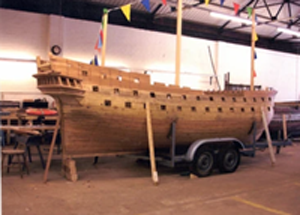
My Father’s Ships My father soon had several ships, the first in 1835 being a schooner built by Edward Brown named "The Kepier", named after the coal mine in which he had a share. She was a ship of 87 tons with a length of nearly 55 feet. The next was a coal collier called, "The John and Ann." He traded these vessels with coals to London for some years from the wharf at Sunderland and often went on business to London and eventually took Old Sun Wharf in Narrow St. Ratcliffe, and also had Thames Wharf, Rotherhithe to where several other ships traded. Also there was "The Primrose", the "William Packet", the "Farmacres", the "Margaret" and the "Dart". (Which last named three, he no doubt chartered) and "The Experiment" also "The Archimedes". Most of these ship’s names I well remember, also after hearing my father talk about the water ballast and the first screw collier, and it is only due to my father to inset here a few words respecting the first screw collier, of which he was the inventor.“The invention of the locomotive engine and the establishment of railway communication between London and the provincial sea ports caused a revolution in the method of carrying coals by sea for the use of the metropolis, a revolution which ultimately extended to the whole carrying trade of the world as carried on by water. The great fleets of sailing ships which within the last fifty years were owned in Sunderland and other local ports have practically ceased to exist and their work is almost wholly done by screw steamers. In shipping and shipbuilding affairs, Sunderland has always had a prominent part. The Wear was pre-eminent as a wood shipbuilding centre, and she now holds an honoured position amongst the iron and steel ship producing rivers of the United Kingdom. So it is fitting that she should be closely identified with the advent of the commercial revolution just mentioned. It is generally believed that the first screw collier was the "John Bowes". This vessel which is still to the fore and is still (1890s) yet actually engaged in the trade for which she was constructed, was built of iron at Messrs. Palmer`s yard Jarrow-on-Tyne. She was launched on 30 June 1852 and loaded her first cargo at Sunderland. Here is a brief account of her first voyage - “The first experiment of the carriage of coals by iron steaming has just been accomplished with perfect success by the "John Bowes". The coasting trade is likely to be carried on in similar vessels as Screw Steamers and thus prevent the encroachment, now being made by the railways. The "John Bowes" commenced loading her cargo of 540 tons of coal at Sunderland on a Wednesday at noon to enable her to sail at midnight, and completed her passage to the Collier docks attached to the East and West India Railway at Blackwall in 48 hours, working only at half speed, in consequence of the newness of the engine. By means of the hydraulic cranes erected at the docks, her large cargo was discharged into railway trucks in the incredibly short time of 18 hours, thus enabling her to leave the dock for the return voyage on Saturday night, water ballast being used in lieu of mud. The old colliers took a month to complete the voyage; this has been done in a week.” Notwithstanding this extract, however, the "John Bowes" was not the first screw collier, for a prior claim to that distinction has been absolutely established by a nephew of mine, a Sunderland ship owner, who is also a coal merchant in London. Mr. Edwin R Ray, of the Old Sun Wharf, Ratcliff, sent the following interesting communication to the "Newcastle Chronicle" in November 1889: "Mr. John Ray, of Sunderland, built the first screw collier viz. "The Experiment" on the North sands Sunderland in the year of 1845, and was the first to carry coals to London by a collier-steamer. This vessel only saw eighteen months when she was burnt at sea. Mr. Ray then bought the "Archimedes" a small government steamer and, prior to 1850, fitted her with tanks for water ballast, and kept her running for some time in the London coal trade, making her light passage in water ballast contained in tanks. Mr. Ray also in the year 1848 enrolled a patent for water ballast and automatic filling of the coals, for the quick delivery of the vessels in London, and I herewith enclose a prospectus of this patent, proving the use of water ballast prior to 1850, and further that it was entirely Mr. Ray’s idea originally, and that the patent was improved upon by others some few years afterwards. Your oldest readers will doubtless recollect the "Experiment SS” and will doubtless know Mr. Ray, as he was a Sunderland man formerly, and they will be glad to know he is still living in a London suburb and is now (1889) 87 years of age. Mr. Hugh Taylor well recollects Mr. Ray starting his screw collier, "The Experiment", as these two gentlemen have been acquainted for the past fifty years." Here is the prospectus issued by Mr. Ray in connection with his patent for water ballast and referred to above - "In our day when mechanical science is making unparalleled strides, and the rage for improvement in every useful art is so predominant, it is quite clear that some cheaper method of conveying coals from the North to London and the outposts of England must, ere long be adopted, otherwise, and at no distant date, the facilities offered to heavy traffic by railways, will supersede and displace a large portion of our coasting and collier ships, the partial effects of which can be seen by the almost entire removal of the carriage of general merchandise from shipping to the sail. However prejudiced the public may have been against the iron ships, (and no-one could be more so than myself four years ago) they will ultimately supersede wooden ships for the coasting trade, provided they can be built as cheap which I believe now to be the case, their durability, capacity for carrying and (if properly constructed) sailing qualities being very much superior. It is well known that an iron ship will not carry herself full of coals. There is therefore abundance of spare room, in which it is proposed to construct a hollow keelson or tunnel along the bottom of the ship, with one or two shafts for drawing the coals up, by the ship’s winch or by a small engine. The latter would be cheaper and quicker, a boy in the tunnel opens a slide by means of a lever, runs the tap full then shuts it; thus two thirds of the cargo will run out with only a boy’s labour. Then the remainder must be filled into the tubs which is quite easy, there being plenty of room to work, thus preventing the great detention consequent on the present mode of breaking down coal laden vessels. By this means a cargo of 300 tons of coal or more may be discharged in one day. Loose caps are provided to put over the holes where the coals have run out, screwed down and made watertight, then a valve is to be opened to fill the tunnel with water, of which it holds sufficient to ballast the vessel with air tubes leading to the dock. All objections to water ballast are fully overcome by it being close confined and the space kept full. When the ship arrives in her loading port she may be laid aground the valve opened and the water will run out, or if she has a small engine, it may be pumped out. By adopting this principle there is at least 15% saved over wooden ships of the same size. The above improvements might be a little more beneficially brought into operation, if adopted by iron steam vessels, as can be satisfactorily explained to anyone interested in the development of the principle herein set forth." I may here say that the claim put forward that my father owned the first steam collier was singularly corroborated in the year 1892 when Mr George Hardy, railway manager and superintendent engineer of the Londonderry Road, Seaham Harbour, wrote to my nephew, Mr. Edwin Ray, stating that he himself well recollected having assisted as first engineer on my father’s boat, "The Experiment" in removing the propeller from the ship for repairs whilst the vessel was lying on the mud at north sands, Monk Wearmouth in the year 1848, after she had been running for some years. This forms conclusive evidence of the priority of my father’s invention, and so the subject may very well be left. |