BACK TO BITS AND PIECES

John Ray (1803-1891) Family, Ships and Sunderland

The frustrations and joys that family history research can bring. We talk to elderly relatives, they tell us from whom they think we were descended and we start on the long trail of proving everything. A few pounds spent on certificates, census information and wills grows into a small fortune as the database increases in size. Cousins appear that you never knew you had. Contacts are made. Then you hit a brick wall and proving anything before about 1800 becomes rather more difficult. Years of frustration can follow until new contacts open up fresh avenues of research

Here we have John Ray in the 1841 census aged 37, living in Northumberland Street, Bishopwearmouth, Sunderland, with wife Ann and three children - Jane aged 14, John aged 11 and Martin aged 10. His occupation is given as wharfinger. Various Sunderland directories chart the progress of his business and premises through the rest of the 19th century; from John Ray, to Ray and Hopper, to E. R. Ray; from wharfinger, to coal owner, ship owner and coal merchant; based in Borough Road, Hendon Lane East, East Hendon Road and Moor Terrace.

A few bricks fall from the wall when his christening record is found. No, not in Sunderland but in London. Surname not Ray but Wray with father John Wray and mother Sophia Burling. Now that we have added a W to the surname perhaps the old relation was right when she indicated that we were descended from Wrays of Richmond, Yorkshire via Wrays of Beamish and Tanfield in County Durham. The wall remained stubbornly solid with no reliable indication of John Wray’s birth place. However, there were plenty of children to sort out, with the added complication that the family decided to dispense with the W in their surname with some returning to it later in life

A cousin wrote about John Ray

Although the family's roots were in NE England, John was born in London where he served an apprenticeship as a dyer. He married a Sunderland girl, Ann Snowball, in 1825 and moved to Gateshead in about 1829, where he took a dyer's shop close to Gateshead church steps. However, his entrepeneurial bent led him into business ventures which seem to have crashed in 1832, when he was able only to repay half the money he owed his creditors. Helped out of his embarrassing circumstances by his friends, in 1833 he took a five year lease on Newcastle Quay in Sunderland where he carried on an extensive business as a wharfinger. He developed into contracting in railway construction, haulage and brick making, By 1839 he was able to repay his creditors in full, earning the presentation of a silver tea and coffee service suitably inscribed


A cousin reveals a journal

Contact with another cousin reveals that John Ray’s eldest child Jane was persuaded by a son-in-law journalist to write a journal of her early life and a draft copy was rescued from a relation’s house clearance. Written in the 1890’s about life in the 1840’s she either had a wonderful memory or had been an avid diary writer. The draft was in a raw state and any transcription may contain errors but it gives vivid pictures of early Victorian life, family, religion and attitudes. More importantly from a family history research point of view, it fills in the gaps and confirms information gathered from other sources.
Go to the journal

A cousin wrote about John Ray’s shipping

After 1839 the 'Kepier', built in 1838, became his first ship. According to her Certificate of Registry she was a schooner rigged of a burden of 87 tons, 55 feet long and 16 feet wide. She had a square stern, a standing bowsprit and a female bust head. By 1841 he had added the 'John & Ann' and the 'Primrose', the 'William Packet' in 1844 and the 'Experiment' was built in 1845/6. By 1842 he was operating from the Old Sun Wharf in Narrow Street, Ratcliff, Middlesex and in 1846/47 he was connected with the Sacriston Colliery where his brother George was manager. He also owned 'Royal Sovereign' which sank in 1848, causing considerable litigation. and at some point he owned the steamship 'Archimedes', said to be the first ship fitted with a screw propeller, designed by F P Smith in 1839. His later ships included the 'Henry Gardner' acquired in 1855 (Captain Weightman), in 1858 the barque 'Moravi' (Captain Philiskirk) and later the barques 'Meg Merriles' and 'Cosmos'. The skipper of the 'Cosmos' was Captain Way, whom John's grandson Clarence met by chance in Brisbane in 1894. At that time Clarence was an apprentice aboard the 'Cutty Sark'.

A cousin locates the John Ray patent

Enquiries led to Patent No 11,782 in AD 1847 titled “Apparatus for Delivering or Discharging the Cargoes of Vessels, applicable to Warehouses, etc.”. The gist of the document is similar to the explanation in Jane’s journal as quoted above but with the major exception that there is no mention of the use of water ballast for ships.

Part of the patent


Model of a screw driven steam boat

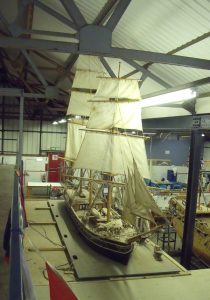
Amongst various models passed down from the estate of John Ray’s grandson Clarence Ray is a model of a screw driven steam boat made from a very appropriate material - coal. The origin is uncertain but it probably dates from John Ray’s time. Is this based on “The Experiment”? We may never know - unless someone out there recognises it!

The Experiment?


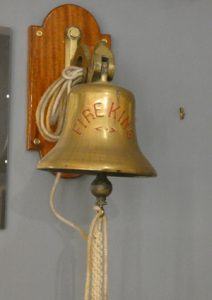
John Ray’s ship - SS John Ray

The ship was 106 feet by 36 feet, 493 gross registered tons. Built by Thompson, Dundee, October 1881, yard number 38. On 27th June 1888 she went ashore south of Flamborough Head when bound north but was refloated. She sank in the River Wear, date uncertain, but was raised. On 11th January 1912 having sailed from Tyne Dock with coal for Yarmouth she ran ashore on Old House Rock five miles south of Scarborough and became a wreck. Her captain at that time was Robert H Cook. Her wreck was discovered by the Scarborough Sub-Aqua Club in 1969. There was a poem about her -

The old JOHN RAY she sails today
She cares for neither wind nor weather
The harder it blows the slower she goes
The old John Ray for ever.

John Ray died in 1891 but the final account of his estate was a decade later. In that account his estate is shown to have been credited with a half share in the ship “John Ray” to the value of £860.


The brick wall crumbles

All these contacts and it still needed a trivial incident to break through the brick wall. John Ray’s younger brother was named Martin Osterfield Wray. He had a wife with the interesting maiden name, so far as we knew, of Jubilee Harriet Theresa Collins. Could we find her christening on that well known internet site? No we could not - until a cousin decided to search for christian names individually. A little quirk of the FamilySearch search engine is that if the christian name for which you are searching is a second or third christian name in the records, the enrty will not show up. Thus searching for Teresa Collins produced Teresa Harriet Jubilee Collins, born on the day of the jubilee of mad King George, with parents James Collins and Margaret who proved to have maiden name Wray. Links with a series of aunts and nieces revealed that John Wray senior did indeed remarry. He married Mary Ann Wright 1st September 1823 in Houghton-le-Spring. She was young enough to assist him in the production of a further eight children. Census entries now indicated that he was born in Ripon, Yorkshire and we quickly found his likely parents, grandparents and great grandparents with emphasis on the area around Otley in Yorkshire. So this leaves us stumbling over the rubble of the broken wall, heading for another barrier. Bring out the ouija board - ancient relative, please discuss.

With particular thanks to cousins Richard Ray, Chris Browning, Peter Neville and Howard Slater.

You can e-mail Chris here     

CLICK TO RETURN TO THE TOP